


What is the Chinese Scholastic Competence Assessment, and why has it become essential for your MBBS application?
Planning to apply for MBBS in China in 2027? Then understanding the CSCA exam is no longer optional. More and more universities now require CSCA scores as part of their admissions process, making it one of the most important changes international applicants need to prepare for.
This guide explains everything you need to know: what the CSCA is, who needs to take it, which subjects are required, how to register, and what it means for your MBBS application.
Purpose: Standardised admission assessment for international undergraduates
Who needs it: Most international applicants to Chinese universities
Subjects offered: Mathematics, Physics, Chemistry, Professional Chinese
English-taught MBBS applicants: Usually Mathematics + Physics + Chemistry only
Exams per year: Five sessions (January, March, April, June, December)
Test language: Chinese or English (for Maths, Physics and Chemistry)
Score validity: Subject to university policy
Registration: www.csca.cn
What Is the CSCA?
Who Needs to Take the CSCA?
What Subjects Are Tested?
Exam Schedule and Format
Fees
How Scores Are Reported and Used
How CSCA Affects MBBS Applicants
University Requirements Comparison
CSCA Application Timeline (2027 Intake)
CSCA Preparation Checklist
Frequently Asked Questions
How SICAS Helps Applicants Prepare for CSCA
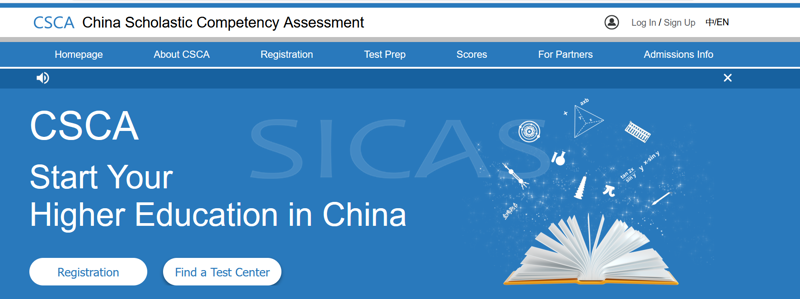
The CSCA (China Scholastic Competency Assessment) is a standardised entrance examination that has been designed for international students who plan to pursue undergraduate degrees in China.
It has been organised by the China Scholarship Council (CSC) and developed in collaboration with experts from Chinese universities. The test has been designed to assess students' language proficiency and academic foundation, helping both universities and applicants determine whether a student is ready for undergraduate study in China.
Since 2026, CSCA scores have become one of the mandatory documents for Chinese universities in undergraduate admissions. Think of it as similar to the SAT in the United States – a standardised measure of academic readiness that universities have begun using as part of their admissions decisions.
For most MBBS applicants, the answer is yes.
Since the 2026/2027 academic year, all international students applying to undergraduate programmes at Chinese Government Scholarship universities have been required to take the CSCA exam and include their scores in the required materials.
This applies to:
All applicants to Chinese Government Scholarship universities – CSCA scores have now become a mandatory component of the admissions review process
Applicants to MBBS programmes – many medical universities, including Shanghai Jiao Tong University School of Medicine, Xiamen University, and Zhejiang University, have begun requiring CSCA scores for English-taught MBBS admissions
Students applying for scholarships – CSCA scores are also being used in scholarship evaluations
Even if you are not applying for a scholarship, many universities have now adopted the CSCA as part of their standard admissions process. It is always best to check your target university's admission notice.
The CSCA has been made open to all students planning to study in China, and a strong score can enhance your application to any Chinese university by showcasing your academic abilities.
The CSCA consists of four subjects: Professional Chinese, Mathematics, Physics, and Chemistry.
| Subject | Duration | Language | Format | Score Range |
|---|---|---|---|---|
| Professional Chinese | 90 minutes | Chinese only | 80 multiple-choice questions | 0-100 |
| Mathematics | 60 minutes | Chinese or English | 48 multiple-choice questions | 0-100 |
| Physics | 60 minutes | Chinese or English | 48 multiple-choice questions | 0-100 |
| Chemistry | 60 minutes | Chinese or English | 48 multiple-choice questions | 0-100 |
All subjects have been scored on a 100-point scale.
Professional Chinese has been offered in two categories: Humanities and STEM.
Applicants applying for Chinese-taught undergraduate programmes have been required to take the Professional Chinese test corresponding to their intended major category
Applicants to fully English-taught undergraduate programmes have been exempted from the test
Applicants to Chinese Language undergraduate programmes may be exempted from the test if they provide a valid HSK Level 4 score
Mathematics has been made compulsory for all applicants, regardless of the programme
Physics and Chemistry: Requirements have varied by university and programme. Applicants to science, engineering, agriculture, or medicine programmes have been generally required to take at least one of these subjects
The requirements have depended on your target university, but here is the general rule:
For English-taught MBBS programmes, applicants have been required to provide CSCA scores in Mathematics, Physics and Chemistry – three subjects
For Chinese-taught medical programmes, applicants have been required to provide CSCA scores in Professional Chinese, Mathematics, Physics and Chemistry – all four subjects
The first global CSCA examination was launched on 21 December 2025. Since 2026, the CSCA has entered a regular operational phase with five test sessions per year:
January
March
April
June
December
It has been recommended that students planning to enrol in Fall 2026 take the exam between December 2025 and April 2026 to ensure timely score submission.
The CSCA has been offered in three formats:
Home-based online test – the primary format, with real-time proctoring
On-site computer-based test – at authorised test centres
Paper-based test – at authorised test centres
The first overseas test centres have been established in Vietnam and Thailand, with more centres being developed in other countries.
The test schedule has taken global time zones into account:
December, April, and June sessions have been prioritised for daytime hours in the Asia-Pacific region
January and March sessions have been prioritised for daytime hours in the Europe, Americas, and Africa regions
The test fees have been set as follows:
One subject: 450 RMB
Two or more subjects: 700 RMB
Scores have been released on different timelines depending on the test format:
Online/Computer-based test: within 7 working days
Paper-based test: within 14 working days
CSCA subjects have all been scored on a 100-point scale.
Importantly, no single passing score has been established for the CSCA. Each university has set its own score requirements based on its programme's standards. Some universities have not yet announced minimum score requirements, so it has been advisable to aim for the highest possible score.
Your CSCA transcript, along with your high school academic records and other supporting materials, has served as a key reference for university admissions and scholarship evaluations.
The introduction of the CSCA has represented a significant shift in China's international medical education landscape.
Before the CSCA, international students applying for MBBS in China had been evaluated primarily on their high school transcripts, English proficiency, and sometimes interviews. The process had varied widely between universities.
Now, the CSCA has provided a standardised measure of academic readiness that all universities have been able to use to compare applicants from different educational backgrounds.
You have needed to plan ahead – The CSCA has not been a test you could take at the last minute. With five sessions per year, you have needed to register and take the test well before your university's application deadline
Subject preparation has mattered more than ever – The mathematics and science components of the CSCA have been academically rigorous. Students who have taken the test have reported that the academic depth has been higher than expected, particularly in mathematics and the sciences
Your target university has determined your subject requirements – Different universities have required different CSCA subjects. Researching your target universities early has become essential so you know exactly which subjects to take
Scores have not been the only factor – CSCA scores have been used alongside your high school transcripts, English proficiency, and other application materials
Different universities have set different CSCA subject requirements for their MBBS programmes. The table below provides a quick reference:
| University | Required CSCA Subjects | Scholarship Available |
|---|---|---|
| Shanghai Jiao Tong University School of Medicine | Mathematics, Physics, Chemistry | ✅ |
| Xiamen University (MBBS) | Mathematics + Physics or Chemistry | ✅ |
| Zhejiang University (MBBS) | Chemistry and Mathematics | ✅ |
| Shandong University (MBBS) | Mathematics and Chemistry | ✅ |
| Peking University Health Science Centre | Check admission notice | ✅ |
| Tongji University | Check admission notice | ✅ |
Always check your target university's admission notice for the exact subject requirements, as these may change each year.
| Timeline | Action |
|---|---|
| September 2026 | Begin researching target universities and their CSCA subject requirements |
| December 2026 | First CSCA exam session – ideal for early applicants |
| January–April 2027 | Additional test sessions – retake if necessary |
| March–May 2027 | Prepare other application documents (transcripts, English test, recommendation letters) |
| June–August 2027 | Submit university applications with CSCA scores |
| September 2027 | Intake begins |
Many universities operate under rolling admission. It has been strongly recommended to apply as early as possible.
□ Research target universities and their specific CSCA subject requirements
□ Confirm which subjects you need to take (Mathematics, Physics, Chemistry)
□ Choose your preferred test session (January, March, April, June or December)
□ Register for the CSCA at www.csca.cn
□ Prepare for each subject using practice questions and mock exams
□ Take the CSCA exam
□ Download your score report when released
□ Include CSCA scores with your university application
□ Submit your application before the deadline
Q: Do I need to take the CSCA if I am applying for an English-taught MBBS programme?
A: Yes, in most cases. English-taught MBBS applicants have been generally required to take CSCA, but they have been exempted from the Professional Chinese subject. The specific subject requirements have varied by university – English-taught MBBS programmes have typically required Mathematics, Physics and Chemistry. Check your target institution's admission notice.
Q: Can I prepare for CSCA without taking HSK?
A: Yes. For English-taught programmes, CSCA and HSK have served different purposes. HSK (Hanyu Shuiping Kaoshi) has assessed general Chinese language proficiency, while the CSCA has assessed academic readiness. English-taught MBBS applicants have been required to take CSCA subjects (Mathematics, Physics, Chemistry) but have not been required to take the Professional Chinese component of CSCA, nor have they been required to provide HSK scores. However, some universities may still recommend or require basic Chinese language training for clinical practice, which has been a separate consideration from CSCA requirements.
Q: Can I take the CSCA more than once?
A: Yes. The CSCA has been offered five times per year. You have been able to take it multiple times if needed, but you have needed to make sure you have your scores before your university's application deadline.
Q: Do universities accept previous CSCA scores?
A: This has depended on the university. Some institutions have accepted CSCA scores from previous test sessions, while others have required scores from the most recent session. CSCA scores have generally been intended for use only during the current application cycle. It has been strongly recommended to check with your target university directly for their specific policy on score validity. When in doubt, taking the most recent available test session has been the safest approach.
Q: What has been considered a good CSCA score?
A: No universal passing score has been established. Each university has set its own standards. Some universities have not yet announced minimum requirements. Aim for the highest score you can achieve.
Q: Where can I register for the CSCA?
A: Registration has been available on the official CSCA website: www.csca.cn.
Q: How long have CSCA scores been valid?
A: CSCA scores have only been used for applications and have only been valid during the application stage. Check with your target university for specific validity requirements.
Q: What if I cannot take the CSCA before my application deadline?
A: Some universities may have offered conditional admission pending CSCA scores. However, this has not been guaranteed. It has been strongly recommended to take the test early and have your scores ready before submitting your application.
Q: Has the CSCA been required for all Chinese universities or only Government Scholarship universities?
A: The CSCA has been mandatory for all applicants to Chinese Government Scholarship universities. Many other universities have also adopted it as a requirement. Check your target university's admission notice for their specific policy.
Q: What subjects have been required for English-taught MBBS?
A: English-taught MBBS applicants have been generally required to take Mathematics, Physics and Chemistry – three subjects. Professional Chinese has not been required for English-taught programmes.
Q: Is the CSCA difficult?
A: Students who have taken the test have reported that the academic depth has been higher than expected, particularly in mathematics and the sciences. Adequate preparation has been essential.
Q: Can I take the CSCA online?
A: Yes. The home-based online test with real-time proctoring has been the primary format. On-site computer-based and paper-based tests have also been available at authorised test centres.
Q: Can I use the same CSCA score for the next year's intake?
A: CSCA scores have generally been valid only for the current application cycle. Check with your target university for their specific policy on score validity.
At SICAS (Study in China Admission System) , we have recognised the challenges that the CSCA has created for international applicants. Through our CSCA platform, we have provided comprehensive support to help students navigate this new requirement.
Students typically need help with:
Choosing the correct CSCA subjects – identifying which subjects their target universities require
Building a preparation timeline – planning when to take the test and how to prepare
Understanding university-specific requirements – navigating the differences between institutions
Preparing supporting documents – ensuring all materials are ready for submission
SICAS provides guidance throughout each stage. Through our platform, we have worked with applicants seeking admission to English-taught MBBS programmes across more than 40 Chinese medical universities, helping them prepare for and succeed in the CSCA.
The CSCA has represented a significant change in how international students have been evaluated for undergraduate study in China. For MBBS applicants, this has meant:
Earlier planning – you have needed to factor CSCA preparation into your application timeline
More standardised evaluation – universities have been able to compare applicants more fairly
Greater emphasis on academic preparation – strong performance in mathematics and sciences has mattered more than ever
From 2028 onward, the examination has been expected to become mandatory for admission to all Chinese universities offering undergraduate programmes for international students.
The universities have continued to improve. The opportunities have remained significant. But successful applications have depended more than ever on understanding new requirements and preparing accordingly.
If you have been applying for the 2027 intake, it has been strongly recommended to register for the CSCA early, check your target university's specific subject requirements, and give yourself enough time to prepare.
As CSCA continues to evolve, applicants who understand the requirements early will have a significant advantage. At SICAS, we continue to monitor policy updates and university admissions requirements so that students can prepare with greater confidence.
Wisser works with SICAS (Study in China Admission System) , where he has advised international students on MBBS admissions, scholarships and university applications in China. Through SICAS, he has worked with applicants seeking admission to English-taught MBBS programmes across more than 40 Chinese medical universities. SICAS has worked with universities across China for more than two decades, supporting thousands of international applicants through the admissions process.
43 MOE-Approved MBBS Universities in China (2026 List & 2027 Outlook) – the complete list with admission quotas
MBBS in China (2026): A Complete Guide for International Students – overview of the admissions landscape
Complete CSC Scholarship Guide for Medical Students – application timelines and eligibility
English-Taught MBBS vs Chinese-Taught MBBS in China – key differences and which one to choose
2026 data has been based on CSCA policy announcements and university admission notices available at the time of writing. All requirements have been subject to official updates from the CSC, MOE, and individual universities.