


If you are planning to apply for an undergraduate degree in China in 2027, there is one academic requirement you should pay attention to early: CSCA.
CSCA stands for the China Scholastic Competency Assessment. It is an academic ability assessment designed for international students applying for undergraduate study in China.
CSCA is not yet a universal requirement for every international undergraduate application. However, since the 2026/2027 academic year, it has become an increasingly important part of undergraduate admission, particularly for programmes and universities participating in the Chinese Government Scholarship system. Many universities have also introduced their own CSCA requirements.
For students preparing for the 2027 intake, the more useful question is therefore not simply:
“Do I need CSCA?”
It is:
“What CSCA requirements apply to my university and programme?”
From our experience working with international students, there is another question that is just as important:
“What difficulties might I encounter that I have not considered yet?”
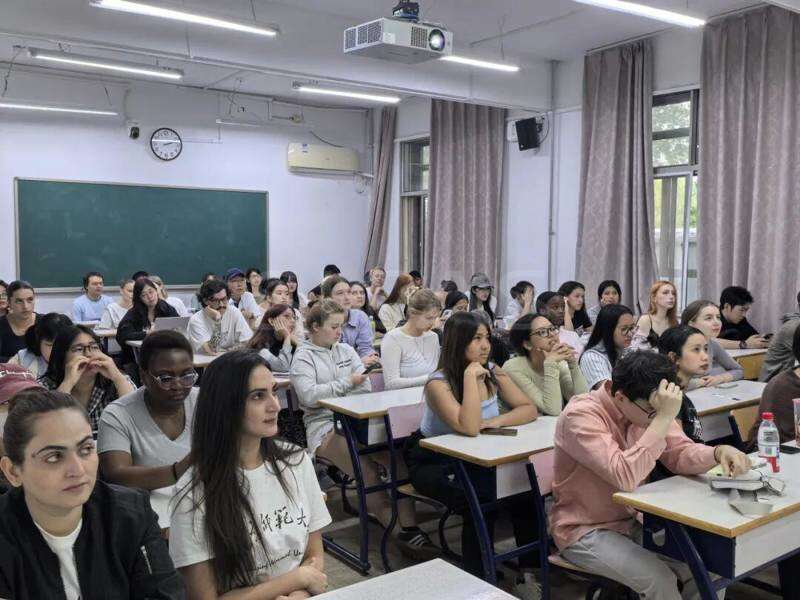
CSCA is more than just another document to upload with an application.
Universities can use CSCA results together with academic transcripts, high school records and other application materials when assessing undergraduate applicants.
The exact subjects required depend on the programme and university. Mathematics is a common requirement, while Physics, Chemistry and Professional Chinese may apply according to the programme and language of instruction. Professional Chinese is the official CSCA name for the relevant Chinese-language subject, which can be understood as an academic Chinese component for certain programmes.
For students applying to English-taught programmes, the relevant CSCA subject papers can be taken in English. This is particularly important for international students who have completed their previous education in English.
However, taking the examination in English does not necessarily mean that every part of the examination will feel familiar.
This is where we have noticed some less obvious problems in actual applications.
A strong high school record does not necessarily mean that a student has covered every topic required by CSCA.
International students come from very different education systems. IB, A-Level and national curricula can place different levels of emphasis on particular areas of mathematics and science.
We have seen students who have studied mathematics for years open CSCA preparation materials and find topics they simply have not encountered before.
This does not necessarily mean that their mathematical foundation is weak.
The topic may simply not have been part of their previous curriculum.
This is why students should compare the CSCA syllabus with what they have actually studied instead of assuming that their high school curriculum will automatically match the examination.
The difference can be even greater for students whose academic background is mainly business, humanities, literature, history or art.
These students may have spent their final years of secondary education developing skills such as essay writing, textual analysis, historical argument or visual analysis.
Those are valuable academic skills.
But they are different from the quantitative skills required in a mathematics examination.
This can be particularly surprising for students applying for Business programmes.
A student may reasonably ask:
“I’m applying to study Business. Why do I need Mathematics?”
The answer is that CSCA requirements are based on the undergraduate admission system, not simply on the subjects a student chose to study at school.
For a student with a humanities-oriented background who has not studied mathematics for several years, returning to algebra, functions or probability can be a much bigger transition than expected.
The problem is not necessarily that the student is “bad at maths”.
It may simply be that they have not been asked to think mathematically for a long time.
There is another difficulty that is easy to overlook: mathematical notation.
The mathematics itself is universal, but mathematical notation and terminology can vary between educational systems.
Some notation used in Chinese mathematics education has roots in the continental European mathematical tradition associated with figures such as Leibniz and Euler. This tradition later influenced Russian and Soviet mathematical education, which in turn had a strong influence on Chinese mathematics education.
The result is not a different kind of mathematics. It is sometimes simply a different way of writing familiar mathematics.
For example, a student trained in the Cambridge system may understand permutations and combinations perfectly well but still hesitate when encountering unfamiliar notation in a CSCA question.
The same can happen with familiar concepts such as the natural logarithm, where notation or terminology may be presented differently.
The student may know exactly how to solve the problem, but first need to recognise what the symbols mean.
In a timed examination, even a small delay can matter.
The problem is not necessarily mathematical ability.
It can be mathematical language.
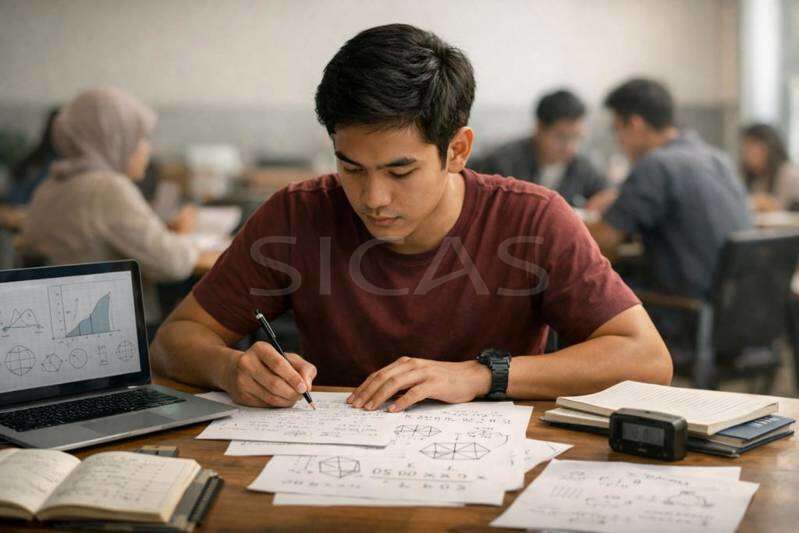
Another issue we often see is that students treat CSCA as something to deal with after choosing a university.
In practice, the order can be more complicated.
A student may first select a programme, discover that CSCA is required, and then realise that they need to prepare for a subject they have not studied recently.
By that point, the application deadline may already be approaching.
This is particularly risky for students who need to rebuild their mathematics foundation rather than simply review what they already know.
The earlier students check the CSCA requirements, the more options they have.
Start by checking the CSCA requirements for your target university and programme.
Then compare the syllabus with your previous studies.
Do not just ask whether you have “studied mathematics”. Ask whether you have actually studied the topics, terminology and notation used in the examination.
If you have not studied mathematics for several years, start early rather than waiting for the application deadline.
For students taking the examination in English, also remember that an English paper removes much of the language barrier, but it does not necessarily remove differences in mathematical terminology or notation.
This is also why SICAS has developed a CSCA Intelligent Training Platform for international students. It combines structured CSCA preparation, practice and mock testing to help students identify weak areas and prepare more systematically.
For 2027 applicants, CSCA should not be treated as just another application document.
The more important point is that international students are coming from different education systems, and the gap between those systems is not always visible from a transcript.
Sometimes the problem is a missing topic.
Sometimes it is a subject that has not been studied for years.
Sometimes it is simply unfamiliar mathematical notation.
These are exactly the kinds of details that can be difficult to notice until a student starts preparing seriously.
At SICAS, our experience with international university applications has shown us that admission problems are often found in these small details rather than in the obvious requirements.
Understanding those details early can make the difference between simply being eligible to apply and being properly prepared to apply.
SICAS (Study In China Admission System) is a platform for international students interested in studying in China. It provides information on Chinese universities, degree programmes, scholarships and admission requirements, helping students explore study opportunities across China.